
Are Motorized Shades Better Than Static Shades for Denton, TX Homes?
Yes. For many Denton, TX homeowners, motorized shades are better than traditional static shades because they make controlling sunlight, glare, privacy, and solar heat faster and more convenient. Instead of manually adjusting shades throughout the day, homeowners can control motorized shades with the push of a button, making consistent shade use much easier during North Texas heat.
Longhorn Solar Screens helps Denton-area homeowners create more comfortable and functional spaces with shading solutions designed around how they actually use their homes. While traditional static shades can provide dependable coverage, they depend on someone being available and willing to adjust them whenever conditions change. Motorized shades remove much of that effort. With professional installation and convenient controls, homeowners can quickly adapt patios, windows, and other sun-exposed areas as the Texas sun shifts throughout the day.
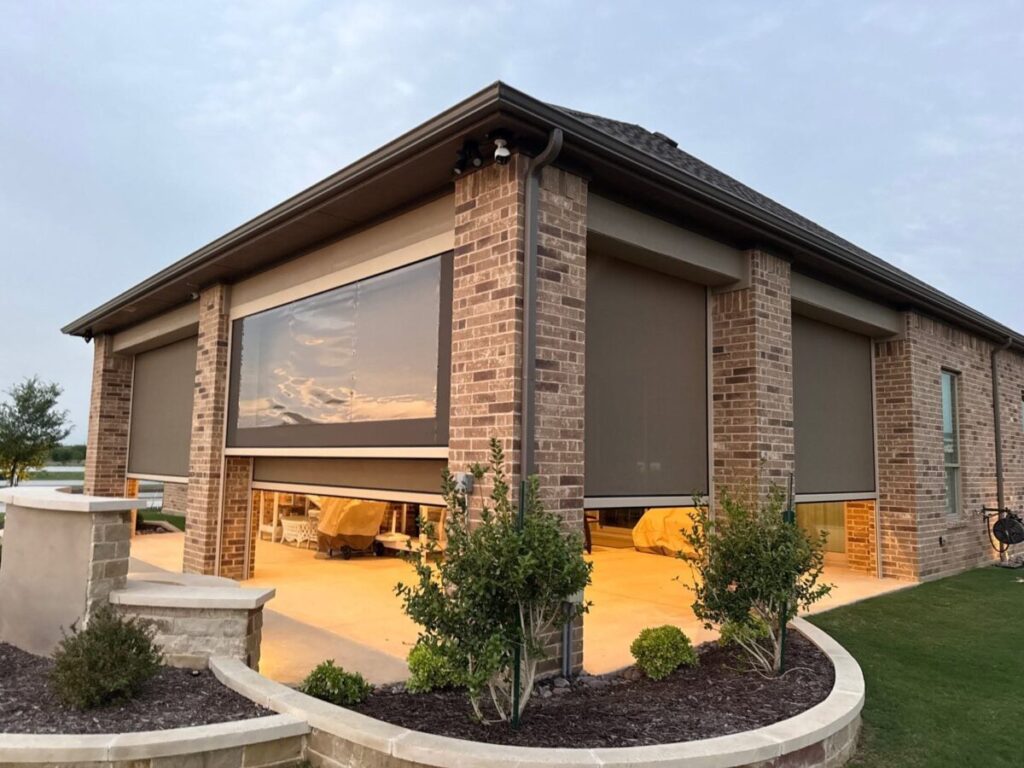
Why Motorized Shades Offer Better Sun Control and Convenience
The biggest advantage of motorized shades is simple: they make effective shade control easier to use consistently. That matters in Denton, where intense summer heat and direct sunlight can quickly change how comfortable a room or outdoor living area feels.
National Weather Service climate normals for Denton show normal maximum temperatures of 95.9°F in July and 95.8°F in August. In conditions like these, being able to deploy shade quickly can be much more practical than repeatedly adjusting a manual or fixed system.
What Is the Difference Between Motorized and Static Shades?
Motorized shades can be raised or lowered using powered controls, while traditional static or manually operated shades require physical adjustment or remain in a fixed position.
That difference changes how homeowners interact with their shade system every day.
Traditional static or manual shades may offer:
- Straightforward sun protection
- Simple operation
- Fewer powered components
- A practical solution for areas where adjustments are rarely needed
Motorized shades can offer:
- One-click raising and lowering
- Easier control over large shade systems
- Quick adjustments as sunlight changes
- Convenient operation from a comfortable location
- More consistent use because adjustment takes less effort
- Automation or scheduled operation when supported by the selected system
The best choice depends on the application. If a shade rarely needs to move, a traditional option may be perfectly adequate. When homeowners expect to adjust their shades frequently, motorization becomes much more valuable.
Why Does One-Click Shade Control Matter in Denton?
One-click operation makes it practical to respond to changing sun exposure instead of simply leaving shades in the same position all day.
Imagine enjoying an afternoon on a patio when direct western sunlight begins pouring into the space. With a manually operated system, someone has to stop what they are doing and adjust the shade. Depending on the size and location of the system, that can become inconvenient enough that homeowners simply leave it alone.
With a motorized system, adjusting the shade can take only moments.
That convenience is especially useful during a Denton summer. National Weather Service data shows that July and August are normally the area’s hottest months, with average daily maximum temperatures approaching 96°F.
Motorized control can help homeowners respond to those conditions while still allowing them to open the shades when they want more daylight, visibility, or an unobstructed view.
Can Automated Shades Help With Energy Efficiency?
Automated shading can contribute to energy savings when shades are appropriately selected, installed, and operated, particularly because automation can make solar heat control more consistent.
The U.S. Department of Energy has highlighted research showing that automated window coverings can reduce unwanted heat gain and improve building energy performance. In one DOE-reported residential experiment, scheduled cellular shades produced approximately 15% HVAC energy savings under the tested conditions. Actual savings in an individual home will vary based on windows, shade type, orientation, insulation, weather, HVAC equipment, and user behavior.
Lawrence Berkeley National Laboratory research has also found that automated shading can outperform manual operation because it responds consistently instead of relying on occupants to remember to adjust shades. One residential modeling study found automated shade controls reduced modeled site energy consumption by roughly 11.6% to 13% on average across the climates and configurations studied.
The principle is particularly relevant in cooling-dominated conditions. Blocking direct solar heat before or while it is making a space uncomfortable can reduce unnecessary heat gain.
For Denton homeowners, the practical lesson is straightforward: a shade only provides its intended benefit when it is actually being used at the right time. Motorization makes that easier.
Are Motorized Shades Worth the Upgrade Over Manual Shades?
Motorized shades are often worth considering when convenience, frequent adjustment, accessibility, or control of large openings are priorities.
Think about how often you expect to operate the shade. Motorization tends to provide the greatest everyday value in areas such as:
- Patios and outdoor living spaces: Quickly lower shades as afternoon sun reaches the seating area.
- Large windows or openings: Avoid manually operating oversized shade systems.
- Frequently used rooms: Make repeated adjustments throughout the day less disruptive.
- Hard-to-reach locations: Control shades without stretching or struggling to reach them.
- Entertainment spaces: Adjust glare and sunlight without interrupting a gathering.
- Smart or automated homes: Depending on the chosen equipment, compatible systems may support scheduled or integrated controls.
The Department of Energy has also reported on a residential automated-shade pilot in which participants noticed improved comfort, with some participants reporting utility-bill decreases of up to 14%. Those results should not be interpreted as a guaranteed savings figure, but they demonstrate why automated shading continues to receive attention as an energy-efficiency strategy.
How Do You Choose Between Motorized and Traditional Shades?
Choose based on how often the shade needs to move, where it will be installed, and how much you value effortless operation.
Before deciding, ask:
- How much direct sunlight does this area receive?
- Will I want to raise and lower the shade every day?
- Is the opening large or difficult to reach?
- Is reducing afternoon glare a priority?
- Do I want to preserve views when shade is unnecessary?
- Would push-button control make me more likely to use the shade regularly?
- Do I want scheduling or automation capabilities?
For a rarely used opening, a manual shade can remain a sensible solution. For a busy patio, frequently used living space, or large sun-exposed opening, motorized shades can make daily operation significantly easier.
Professional guidance also matters. Proper measurements, shade selection, mounting, and installation all influence how smoothly a motorized system performs.
FAQ: Motorized Shades in Denton, TX
Do motorized shades use a lot of electricity?
Generally, no. Shade motors operate for short periods while raising or lowering the material. Lawrence Berkeley National Laboratory research evaluating automated residential shading noted that energy use from the motor, sensors, and microprocessor in the modeled system was very small.
Are motorized shades useful during Texas summers?
Yes. Motorized shades make it easier to control direct sunlight and solar heat when conditions change throughout the day. This is particularly useful in Denton, where normal July and August maximum temperatures are nearly 96°F.
Are manual shades still a good option?
Yes. Manual or static shades can be a good choice for areas that require infrequent adjustment or where simple operation is the priority. Motorization becomes more compelling when homeowners want frequent, convenient control.
Can motorized shades automatically adjust throughout the day?
Some motorized shading systems can support scheduling, sensors, remote controls, or compatible automation features. Available functions vary by product, so homeowners should discuss their preferred level of control before selecting a system.
Upgrade Your Denton Home With One-Click Shade Control
Static shades can block sunlight, but motorized shades make controlling that protection significantly more convenient. In Denton’s hot, sunny climate, the ability to adjust shade quickly can help homeowners manage glare, solar heat, privacy, and comfort without repeatedly stopping to operate shades by hand.
Longhorn Solar Screens can help you determine which shading solution fits your home’s openings, sun exposure, and everyday routine.
Ready to leave old-school shade adjustment behind? Contact us to explore motorized shade options for your Denton, TX home.